
Professional Mirror Mounting: A Guide to Secure Installation in Swiss Homes
A single 10-millimeter drilling error in a Zurich apartment can cost you more than 1,200 CHF in repair fees and shattered glass. It’s a stressful moment when you realize that your 15-kilogram designer mirror is held up by nothing more than hope and the wrong wall plug. If you’re searching for professional mirror mounting zurich, you already know that Swiss walls demand precision. You likely feel the pressure of distinguishing between solid concrete and aerated brick while worrying about the high-voltage lines hidden just centimeters beneath the surface.
You deserve the peace of mind that comes with a perfectly secure and level installation. This article teaches you the professional techniques for mounting mirrors on any wall type to ensure safety and perfect alignment in your home. We’ll walk through the essential tools like hammer drills and specialized anchors, ensuring your mirror stays exactly where it belongs without damaging your property.
Key Takeaways
- Identify your specific wall material, such as solid Swiss concrete or brick, to ensure you select the specialized masonry bits and wall plugs required for heavy loads.
- Master the use of essential tools like multi-detectors to safely navigate hidden electrical lines and spirit levels for achieving flawless horizontal alignment.
- Understand the critical safety limits of mounting hardware, including why adhesive strips should never be used for any mirror weighing more than 2kg.
- Learn the step-by-step professional technique for marking and drilling to the exact depth needed to maintain long-term structural integrity and safety.
- Recognize when to engage a professional mirror mounting zurich service for complex installations involving over-sized glass or delicate surfaces like marble and tile.
Understanding Your Walls: The Foundation of Secure Mirror Mounting
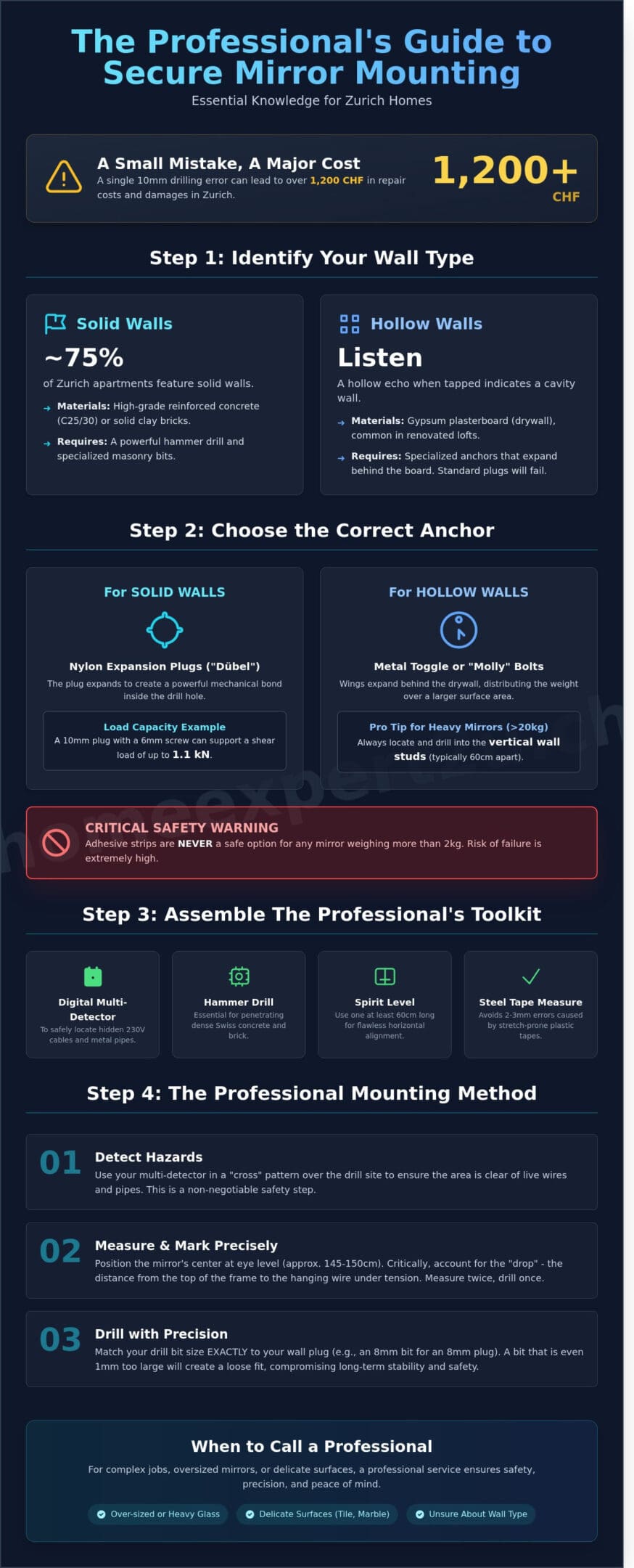
Before you begin your project for mirror mounting zurich, you must identify what lies behind the paint. The structural integrity of your installation depends entirely on the material density of your wall. In Switzerland, residential construction typically falls into two categories: solid mineral-based walls or hollow partition systems. Approximately 75% of apartment buildings in the Zurich area utilize reinforced concrete or solid masonry for load-bearing structures, which demands a specific technical approach.
Swiss building standards favor durability, meaning you’ll likely encounter high-grade concrete or clay bricks. These materials require specialized masonry drill bits with tungsten carbide tips. The “Dübel,” or wall plug, is the most critical component in this process. It creates a mechanical bond by expanding against the internal surface of the drill hole as the screw enters. This expansion generates the friction necessary to hold heavy glass. If the wall density isn’t matched with the correct hardware, the plug won’t grip, leading to structural failure and potential property damage.
Solid Concrete and Brick Walls
Load-bearing walls in modern Swiss apartments are built to last, often using C25/30 grade reinforced concrete. You’ll need a hammer drill with an SDS-plus chuck to penetrate these surfaces; a standard rotary drill won’t suffice. For these high-density materials, nylon expansion plugs are the industry standard. A 10mm plug paired with a 6mm screw can typically support a shear load of up to 1.1 kN. This ensures even the heaviest ornate mirrors remain securely fixed to the masonry.
Drywall and Hollow Partition Walls
Internal walls in renovated lofts or newer conversions often consist of gypsum plasterboard. You can identify these by tapping the surface; a hollow echo indicates a cavity wall. Because these surfaces lack the structural mass of concrete, standard plugs will pull right through the board. You should use metal toggle bolts or specialized “Molly” bolts that expand behind the board to distribute weight. For mirrors exceeding 20kg, professional mirror mounting zurich experts always locate the vertical studs, which are typically spaced at 60cm intervals in Swiss drywall systems, to provide a solid anchor point.
Essential Tools and Preparation for a Flawless Result
Achieving a professional finish requires more than just a hammer and a nail. In a city where precision is expected, especially for mirror mounting zurich projects, your preparation determines the longevity of the installation. You’ll need a toolkit that includes a spirit level (at least 60cm long), a digital multi-detector, a power drill with a hammer function, and a steel measuring tape. Don’t rely on plastic tapes as they can stretch and cause 2-3mm errors that become visible once the mirror is up.
A digital multi-detector is a non-negotiable safety tool. Swiss apartments often feature thick masonry or concrete walls where electrical conduits and water pipes follow unpredictable paths. A high-quality detector identifies live 230V cables and metal pipes hidden behind 15mm of plaster. Before you start, inspect the back of your mirror. Check if the pre-installed wire is frayed or if the D-rings are loose. If you’re hanging a 25kg mirror, ensure your hardware is rated for at least 35kg to provide a necessary safety margin. If the task seems daunting, you can always find professional assistance to ensure a secure fit.
Safety Equipment and Pre-Drilling Checks
Start by using the digital detector in a “cross” pattern over your intended drilling site. This confirms the area is clear of hazards. To protect your home, lay down a 2×2 meter drop cloth. Masonry dust from Swiss concrete is incredibly fine and abrasive; it can scratch parquet or laminate floors in seconds. Always match your drill bit size exactly to your wall plugs. For a standard 8mm heavy-duty plug, use an 8mm masonry bit. Using a bit that’s even 1mm too large will result in a loose fit that compromises the mirror’s stability over time.
Calculating the Ideal Mirror Height
Visual balance is the difference between a DIY look and a professional gallery finish. For hallways and bathrooms, the standard guideline is to place the center of the mirror at eye level, which is approximately 145 cm to 150 cm from the floor. You must account for the “drop” factor. This is the distance between the top of the mirror frame and the actual hanging point on the wire or bracket.
- Measure from the top of the mirror to the hanging hardware while it’s under tension.
- If the wire has 7 cm of slack, your drill hole must be exactly 7 cm lower than your desired top-edge mark.
- Align the mirror’s vertical axis with the center of your furniture. For a 120 cm wide console table, the mirror’s center point must sit exactly at the 60 cm mark.
Adopting a “measure twice, drill once” philosophy prevents unnecessary holes in your masonry. Take your time to mark the wall with a sharp pencil, then step back 3 meters to verify the placement looks balanced within the room’s architecture before the first bit touches the wall.
Step-by-Step: How to Mount a Heavy Mirror Safely
Securing a heavy mirror requires more than just a steady hand; it demands technical precision and the right equipment for Zurich’s diverse wall types. Whether you’re dealing with solid concrete in a modern Altstetten apartment or older masonry in District 1, the process begins with exact measurements. Use a high-quality spirit level to mark your drilling points. A deviation of even 2mm can become visually distracting once a large mirror is in place. Professional mirror mounting zurich services often use laser levels to ensure 100% horizontal accuracy across wider spans.
Once you’ve marked the spots, select a drill bit that matches your wall plug’s diameter exactly. Drill the holes approximately 5mm deeper than the length of the plug. This extra depth prevents the plug from bottoming out before it’s fully inserted. Push the wall plugs into the holes until they sit perfectly flush with the wall surface. If a plug protrudes even slightly, the bracket won’t sit flat, which compromises the mirror’s stability and creates an uneven load distribution.
Drive your screws or heavy-duty hooks into the plugs. Leave about 5mm of clearance between the screw head and the wall to allow the mirror’s mounting hardware to grip securely. Before you attempt to lift the mirror, double-check that every screw is rigid and shows no movement under manual pressure.
Precision Drilling Techniques
Drilling into tiled surfaces in Swiss bathrooms requires extra care to prevent cracking. Place a piece of masking tape over your mark to stop the drill bit from slipping during the initial seconds of contact. Always clear the dust from the hole using a vacuum or a manual blower. Debris left inside can reduce a wall plug’s grip by up to 25%. If you find a slight misalignment after the first hole, you can often compensate by slightly angling the second hole before the plug is fully seated.
The Final Hanging Process
Safety is the priority during the final stage. You should never attempt to lift a mirror weighing over 15kg alone; always follow the two-person rule to prevent injury or glass breakage. Carefully guide the mirror onto the hooks and listen for the hardware to seat fully. Once it’s hooked, maintain your grip while your partner verifies the alignment. Perform a final leveling check with the spirit level and wipe away any fingerprints with a microfiber cloth to finish the installation professionally.
Safety First: Weight Limits and Avoiding Common Pitfalls
Safety isn’t just about the moment you let go of the mirror. It’s about long-term stability in your living space. You must distinguish between shear force and tension force to choose the right hardware. Shear force pulls vertically down against the fastener, while tension force pulls it directly out of the wall. For a standard wall mount, shear force is your main adversary. Professional mirror mounting zurich services prioritize hardware that maximizes shear resistance to prevent catastrophic falls.
Don’t rely on adhesive strips for any mirror exceeding 2kg. Even high-grade tapes lose 35% of their bonding strength when indoor humidity fluctuates or temperatures rise during Swiss summers. Similarly, avoid hanging heavy mirrors on a single wire. Wire creep occurs as the metal strands stretch over several months. This eventually causes the mirror to sit crooked or the wire to snap entirely. D-rings attached directly to the frame provide a permanent, non-stretch solution that keeps the glass level.
Load Capacity Guidelines
Concrete walls in Zurich apartments require specific wall plugs for a secure hold. A standard 6mm nylon plug typically supports 15kg in solid masonry. An 8mm plug handles up to 25kg, and a 10mm plug is necessary for items over 40kg. If your mirror exceeds 30kg, distribute the load across at least two mounting points. Antique mirrors often have fragile frames. These require bottom-weighted J-channels to take the pressure off the aged wood and prevent the frame from pulling apart under its own weight.
Common Mounting Mistakes to Avoid
- Wrong screw length: The screw must be 5mm longer than the wall plug plus the thickness of your mounting bracket.
- Drilling into mortar: Never drill into mortar joints. Mortar has 60% less holding power than the brick or stone itself.
- Ignoring instructions: Always follow the mirror manufacturer’s specific weight limits. Ignoring a warning on the back of a 600 CHF designer mirror is a risk you shouldn’t take.
Inspect your mounts twice a year. Look for fine cracks in the plaster or a tiny gap between the wall and the frame. If you notice the mirror tilting even 2mm, the fastener is likely failing. For a secure and professional installation that protects your investment, you can book our expert mounting service to ensure your home remains safe.
When to Hire a Professional Mounting Service
While DIY projects often provide a sense of accomplishment, certain scenarios demand a specialist’s touch. Large-scale mirrors or floor-to-ceiling glass installations involve significant weight and fragile materials that require precise handling. Attempting to drill into delicate marble, decorative glass, or high-end tiles without the right experience often leads to costly fractures. In Switzerland, replacing a single damaged bathroom tile or a stone slab can easily exceed CHF 450 in labor and material costs. Professionals use diamond-tipped masonry bits and specific pressure settings to prevent these expensive accidents.
Professional mirror mounting zurich services are also a strategic choice for rental properties. Swiss rental contracts are notoriously strict regarding wall damage and structural integrity. An expert ensures the load is distributed correctly using the right anchoring systems, preventing structural cracks or oversized holes that could jeopardize your security deposit. If you lack heavy-duty equipment like hammer drills for reinforced concrete or electronic stud finders, hiring an expert is the safest route to protect your investment. Similarly, if you’re planning to mount other heavy items like large televisions, consider professional TV wall mounting in Zurich to ensure all your valuable electronics are securely installed.
Consider the complexity of the task before you start. If the mirror weighs more than 20kg or requires mounting on a sloped ceiling, the margin for error disappears. A professional brings the necessary manpower to lift and secure the piece without risking injury or breakage.
The Benefits of Expert Handyman Services
Professionals bring more than just a ladder to your home. They provide access to industrial-grade fasteners, such as heavy-duty toggle bolts and M6 anchors, which aren’t always available in standard hardware kits. You benefit from full liability insurance and a formal guarantee on the work performed. This protection is vital for oversized mirrors that could cause significant damage if they fell. Experts complete the task in a fraction of the time, typically finishing a complex installation in under 60 minutes while leaving your space spotless.
Home Expert 2 U: Your National Mounting Specialists
Our technicians possess deep experience with every Swiss wall type, from historic stone in Altstadt apartments to modern Rigips in new builds. We provide transparent hourly rates for all mounting and assembly tasks, ensuring you receive premium service without hidden surcharges. For a secure, perfectly leveled result that meets all local safety standards, book your professional mirror mounting zurich here. We handle the technical details so you can enjoy your home’s new aesthetic with total peace of mind.
Bring Lasting Safety and Style to Your Home
Hanging a heavy mirror requires more than just a nail and a hammer. You’ve learned that identifying your wall material is the first step toward a secure installation. Whether you’re dealing with solid Swiss concrete or modern drywall, using the right anchors prevents costly damage. Safety remains the priority when handling items over 15kg. If you’re unsure about weight limits or lack professional masonry tools, seeking expert help is the smartest choice for mirror mounting zurich.
HomeExpert2u provides expert technicians who are intimately familiar with Swiss building standards. Our team arrives fully equipped with specialized safety tools to handle even the most delicate glass. You’ll benefit from our transparent pricing model starting at CHF 95 per hour; this ensures you never face hidden fees or unexpected costs. We’ve helped over 500 homeowners in the region secure their valuables with precision and care.
Book Professional Mirror Mounting Services
Your walls deserve the best care to keep your home beautiful and safe for years to come.
Frequently Asked Questions
Can I mount a mirror on a tiled bathroom wall without cracking the tiles?
Yes, you can safely mount mirrors on tiles by using a diamond-tipped drill bit and masking tape to prevent slipping. Apply a piece of tape over the drill point to stabilize the surface. Start the drill at a low speed of 500 RPM without the hammer function to avoid structural fractures. This precision ensures your bathroom installation remains intact and professionally finished.
How do I know if my wall is strong enough to hold a 20kg mirror?
You can determine wall strength by performing a knock test or using a digital stud finder. Solid concrete walls in Swiss apartments easily support 20kg when using 8mm nylon plugs. If your wall sounds hollow, it’s likely plasterboard, which requires specialized toggle bolts. For a 20kg mirror, ensure each fixing point is rated for at least 15kg to provide a necessary safety margin.
What is the best type of wall plug for solid concrete walls?
High-quality nylon expansion plugs, such as the Fischer UX 8mm, are the gold standard for solid concrete. These anchors expand in four directions to provide maximum grip within the masonry. For professional mirror mounting Zurich residents often choose 10mm plugs for mirrors exceeding 15kg. This hardware ensures the mounting remains secure even under the constant tension of a heavy glass pane.
Is it possible to mount a mirror without drilling holes?
You can mount mirrors without drilling by using industrial-strength mounting tape or specialized mirror adhesive. This method is effective for mirrors weighing less than 8kg on smooth, non-porous surfaces. Products like Pattex No More Nails can hold up to 10kg per strip. However, for heavier items, mechanical fixings are essential to prevent the mirror from falling due to temperature fluctuations or humidity in the room.
How high should a mirror be hung in a hallway?
Hang your hallway mirror so the center point is approximately 155cm from the floor. This standard height aligns with the average human eye level, making it functional for most users. If you’re placing it above a console table, leave a gap of 15cm to 20cm between the table surface and the bottom of the frame. This spacing creates a balanced visual aesthetic in narrow Swiss entryways.
What should I do if I accidentally drill into a hollow space in the wall?
If you hit a hollow space, stop drilling immediately and switch to a metal toggle bolt or a cavity anchor. These specialized fixings expand behind the wall board to distribute weight across a larger surface area. An M5 toggle bolt can support up to 20kg on a single layer of 12.5mm plasterboard. Never try to use standard concrete plugs in a hollow gap as they’ll fail instantly under load.
Do I need a special drill for Swiss apartment walls?
Most Swiss apartment buildings use reinforced concrete, so you’ll need an SDS-plus hammer drill with a masonry bit. A standard cordless drill often lacks the impact energy required to penetrate these 20cm thick structural walls. Using a drill with at least 2.0 joules of impact energy makes the process efficient. For complex mirror mounting Zurich experts recommend checking for electrical conduits using a Bosch detector before you start.
How can I hide the mounting hardware on a frameless mirror?
You can hide mounting hardware by using Z-clips or recessed French cleats attached to the back of the mirror. These interlocking metal strips have a slim 5mm profile that keeps the mirror nearly flush against the wall. Alternatively, use specialized mirror glue if the surface is perfectly flat. This approach creates a floating effect that’s popular in modern Swiss interior design while maintaining a clean, hardware-free appearance.