
Kitchen Installation Checklist Zurich: A 2026 Guide to a Stress-Free Remodel
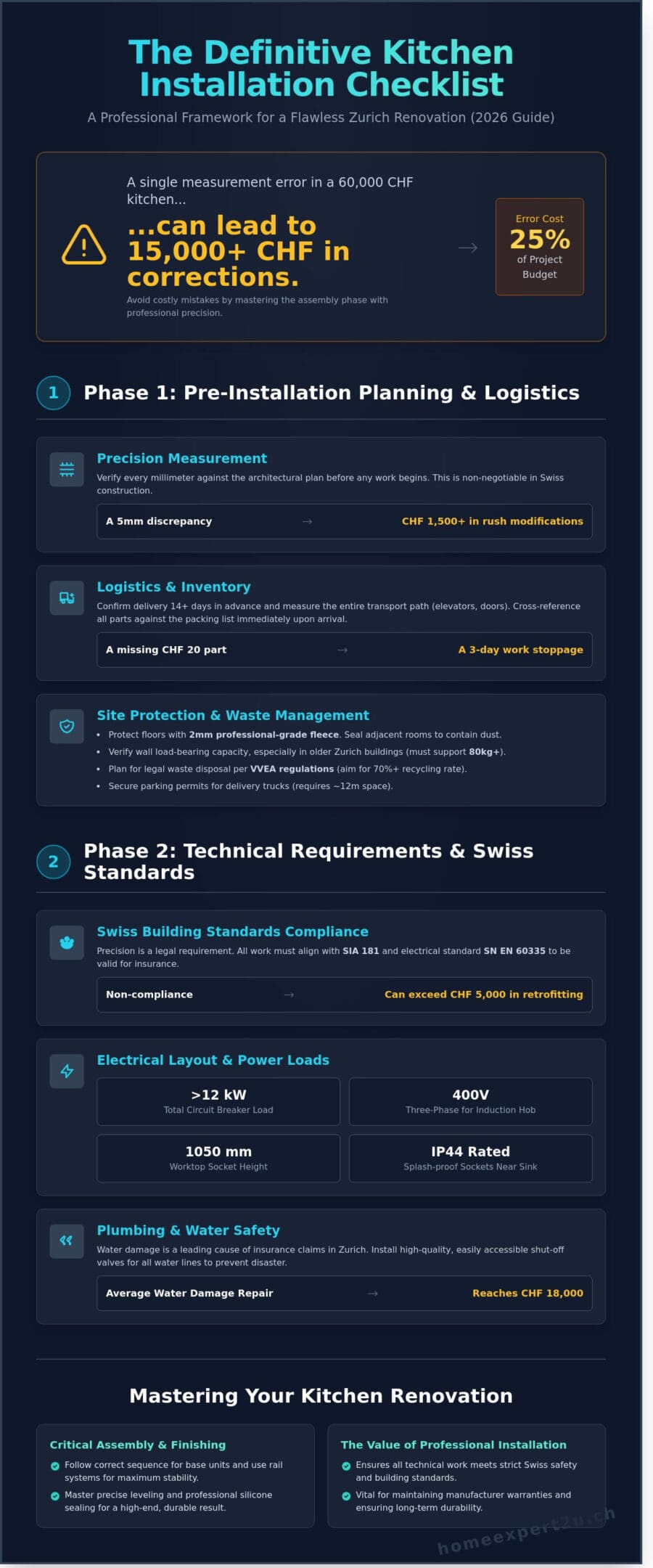
A single measurement error in a 60,000 CHF kitchen remodel often leads to over 15,000 CHF in structural corrections before you’ve even turned on the stove. You’re likely feeling the pressure of coordinating multiple trades while trying to ensure every detail aligns with strict Swiss building regulations. It’s common to worry about whether the electrical wiring is truly up to code or if the plumbing will fail a future inspection. This 2026 guide provides the definitive kitchen installation checklist zurich to guarantee your renovation meets SIA 181 standards without the typical stress of missing parts or misaligned pipes. We’ve built this professional framework to help you master the assembly phase with the precision of a Swiss watchmaker. You’ll learn exactly how to sync your assembly schedule with local experts, verify technical specifications for high-end appliances, and avoid the expensive mistakes that often derail Swiss home projects. We’ll examine the critical path from the first wire to the final cabinet handle to ensure your investment delivers a flawless, high-performance result.
Key Takeaways
- Learn how to coordinate critical logistics and verify precise dimensions before removal to ensure a seamless transition to your new kitchen.
- Navigate complex local regulations by using our comprehensive kitchen installation checklist zurich to ensure all technical work meets strict Swiss safety standards.
- Discover professional assembly techniques, including the correct sequence for base units and the use of specialized rail systems for maximum cabinet stability.
- Master the essential finishing touches, such as precise leveling and professional silicone sealing, to protect your surfaces and ensure a high-end result.
- Understand why professional installation is a vital investment for maintaining manufacturer warranties and ensuring long-term durability in the Swiss market.
Phase 1: Essential Pre-Installation Planning and Logistics
Your journey to a modern Swiss kitchen starts with a rigorous kitchen installation checklist zurich to avoid costly delays. Success in a 2026 remodel depends on precision. You must verify every millimeter of your space against the final architectural plan before you touch a single screwdriver. Even a 5mm discrepancy in a corner can prevent a bespoke cabinet from fitting, potentially costing you CHF 1,500 in rush-ordered modifications. Confirm your delivery date at least 14 days in advance and walk the transport path. Measure door frames and elevator widths in your Zurich apartment block to ensure your 90cm wide refrigerator actually reaches the kitchen.
Inventory management is your next priority. Swiss suppliers provide detailed packing lists that you should cross-reference immediately upon delivery. Don’t wait for the installer to arrive to discover a missing handle or a cracked stone countertop. Identifying a missing CHF 20 hardware component now prevents a three-day work stoppage later. While the work progresses, your daily life continues. Set up a functional “kitchenette” in a separate room. Move your coffee machine, microwave, and a small fridge to this temporary zone to maintain your sanity during the two-week intensive build phase.
Site Preparation and Protection
Protecting your home is a non-negotiable step in any kitchen installation checklist zurich. Cover your parquet or stone flooring with 2mm professional-grade protective fleece or hardboard to prevent impact damage. Seal adjacent rooms with heavy-duty plastic sheeting and zip-doors to trap fine masonry dust. Before hanging heavy upper cabinets, verify that your walls meet current building code standards for load-bearing capacity. This is especially vital in older Zurich buildings where lath and plaster walls might require additional reinforcement before supporting 80kg of cabinetry and dinnerware.
Logistics and Waste Management
Swiss environmental laws are strict. You must plan for the legal disposal of your old kitchen components according to VVEA regulations (Verordnung über die Vermeidung und die Entsorgung von Abfällen). Most Zurich projects require a 6m³ skip or a professional disposal service that guarantees a recycling rate of at least 70%. If you live in a high-density area like District 4 or 5, check with the local police department for temporary parking permits. The delivery truck needs a clear 12-meter space to unload safely. Finally, locate and test your main water and electricity shut-off valves. Knowing exactly how to cut the power in an emergency is a safety essential for every homeowner.
Phase 2: Technical Requirements and Swiss Building Standards
Your kitchen installation checklist zurich must prioritize strict adherence to local technical regulations. In Switzerland, precision is a legal requirement rather than a suggestion. You must ensure all electrical installations align with the SN EN 60335 series and the specific Swiss building practice codes established by the SIA. Following these guidelines ensures your remodel remains valid for insurance purposes and meets the safety benchmarks required in the Zurich canton. Proper planning prevents costly retrofitting, which can often exceed CHF 5,000 if structural changes are needed after the cabinets are mounted.
Electrical Layout and Power Loads
Modern Swiss kitchens in 2026 demand significant energy management. A standard induction hob requires a 400V three-phase connection, while ovens and dishwashers typically operate on separate 230V circuits. You need to verify that your circuit breaker handles a simultaneous load exceeding 12 kW to prevent power failures during peak usage. Precision mapping is essential for a seamless finish.
- Install splash-proof sockets (IP44 rated) for any outlets located within 60 cm of the sink area.
- Position worktop sockets at a height of 1050 mm to clear standard 900 mm counter heights.
- Place heavy appliance sockets at 300 mm above the floor, ensuring they don’t interfere with the appliance housing.
- Plan for under-cabinet LED lighting with accessible, hidden transformers for easy maintenance in the future.
Plumbing and Water Safety
Water damage remains a leading cause of insurance claims in Zurich, with average repair costs reaching CHF 18,000 for high-end apartments. You must install high-quality shut-off valves for both hot and cold water lines to allow for isolated repairs. Ensure the dishwasher drain is correctly looped at least 150 mm above the trap. This prevents backflow and eliminates the risk of stagnant odors entering your clean dishes.
In the Zurich metropolitan area, water pressure typically ranges between 3 and 5 bar. If your building’s pressure exceeds 5 bar, you should install a pressure reducer. This protects your Swiss-engineered appliances from premature seal failure. If you’re uncertain about your current infrastructure, you can consult with a local expert to evaluate your home’s technical readiness before purchasing new appliances.
Ventilation and Energy Standards
Modern Zurich buildings often follow Minergie or similar energy-efficient standards. These structures are airtight, meaning your ventilation choice is critical. You must choose between a recirculating hood with activated carbon filters or an exhaust system. If you select an exhaust hood, Swiss law requires a coordinated air supply solution to prevent dangerous pressure imbalances. Always verify these requirements with a certified ventilation specialist to ensure your kitchen installation checklist zurich covers the necessary permits for 2026 compliance.
Phase 3: The Step-by-Step Kitchen Assembly Checklist
The assembly phase transforms your empty space into a functional room. You must begin with the corner base units. These act as the anchor for the entire layout, ensuring the rest of the run remains straight. In Zurich, where many apartments feature walls that aren’t perfectly square, this starting point is non-negotiable. Use a high-precision spirit level to check both horizontal and vertical planes. Every unit requires individual leveling via adjustable feet. A 1mm deviation at the start can result in a 10mm gap by the end of a 4-meter run. Once aligned, secure the units to the wall using heavy-duty fixings and screw them to each other to create a rigid, unified structure. For upper cabinets, professionals always use a rail system. It distributes weight evenly and provides a 100% secure mount, which is crucial for safety when storing heavy ceramic dishes.
Cabinet and Hardware Installation
Precision follows the structure. Assemble your internal pull-out systems and drawers according to the 2026 manufacturer guidelines to ensure soft-close mechanisms function correctly. Attach door hinges for a rough alignment; you’ll perform the final fine-tuning once the worktops are in place. Use a drilling template for handles and knobs. This prevents the common mistake of asymmetrical placement, which is immediately visible to the eye. A professional finish relies on these millimeter-perfect details. Following a detailed kitchen installation checklist zurich ensures you avoid costly mistakes during this high-stakes phase.
Worktop and Appliance Fitting
The worktop installation is the most critical part of your kitchen installation checklist zurich. Measure twice before cutting openings for the sink and hob. You must leave a 2mm expansion gap if you’re using natural stone or wood to account for humidity changes in the Swiss climate. Slide appliances like the dishwasher and oven into their designated housings. Secure them firmly to the cabinetry so they don’t shift during use. Finally, connect the sink and faucet. Run the water at full pressure for at least 5 minutes to test for leaks before the cabinetry absorbs any moisture. This step prevents water damage that could cost upwards of CHF 2,000 in repairs if left undetected.
Phase 4: Post-Installation Quality Checks and Finishing
Once the heavy lifting is complete, the difference between a standard remodel and a premium Zurich finish lies in the final 5% of the work. Your kitchen installation checklist zurich must prioritize a rigorous inspection before you sign off on the project. Start by verifying the level of all work surfaces using a digital spirit level. In Swiss construction standards, a deviation of more than 1.5mm per meter is typically considered outside professional tolerances. Check that cabinet doors sit perfectly flush. Even a minor tilt can cause uneven wear on hinges over time and disrupt the visual symmetry of the room.
Testing is the next critical step. Don’t just turn the oven on; run a full 15 minute cycle on the dishwasher to check for leaks at the intake and drainage points. Ensure the induction hob recognizes cookware on every zone and that the extractor fan clears steam effectively at all power levels. This prevents the frustration of discovering a faulty connection weeks later. Finally, clear all construction dust. Zurich apartments often feature sensitive materials, so use a vacuum with a HEPA filter for drawer runners and pH-neutral cleaners for worktops to remove any stubborn adhesive residue without damaging the finish.
The Fine-Tuning Process
Modern Swiss cabinetry relies on 3D adjustable hinges that require precision handling. You should ensure that the vertical, horizontal, and depth gaps between doors are uniform, typically staying within a strict 2mm margin for a “seamless” look. Test every soft-close drawer and cupboard. They should glide shut without any mechanical resistance or clicking sounds. Verify that the kickplates, or plinths, are cut to the exact floor contour and secured firmly to the cabinet feet. This prevents debris from accumulating in hard-to-reach areas under your units.
Professional Silicone Sealing
The local climate and high standards for hygiene in Switzerland make high-quality sealing mandatory. Use premium anti-fungal silicone specifically designed for kitchen environments to prevent mold growth in damp corners. A continuous, smooth bead must be applied around the sink, the hob cutout, and the junction where the worktop meets the wall. Professional silicone sealing is the most critical step for preventing long-term water damage. This barrier stops moisture from swelling the cabinet carcass, which can lead to structural failures and repairs costing upwards of CHF 2,500 if the seal fails.
If you’re planning a full property update alongside your remodel, you can get a professional property valuation to see exactly how your new kitchen impacts your home’s market price in the current Zurich landscape.
Why Professional Support is the Best Investment for Your Kitchen
Completing your kitchen installation checklist zurich requires more than just ticking off boxes. It demands technical precision that most homeowners can’t achieve alone. Professional installers bring specialized tools like heavy-duty track saws for millimetre-perfect stone cuts and laser levels for mounting heavy wall units on Swiss concrete walls. These tools ensure your cabinets don’t just look good; they stay securely fastened for decades.
Hiring experts protects your financial investment. Most high-end manufacturers in Switzerland only honor their 10 or 25-year warranties if the assembly meets specific professional standards. If a DIY error causes a hinge to fail or a drawer runner to warp, you’ll likely pay the full replacement cost yourself. Trained technicians also act as a safety net. They identify faulty 230V electrical connections or slow plumbing leaks before they’re hidden behind expensive cabinetry, preventing water damage that could cost upwards of CHF 5,000 to repair.
- Specialized Equipment: Pros use industrial-grade suction lifters and precision jigs that DIY kits lack.
- Warranty Protection: Certified installation keeps manufacturer guarantees fully enforceable.
- Project Management: A dedicated handyman service coordinates the delivery, assembly, and cleanup.
- Risk Mitigation: Experts spot structural or utility issues early, saving you from future disasters.
Comparing DIY vs. Professional Assembly
Time is your most valuable asset during a remodel. A professional team typically completes a full setup in 1 to 2 days. In contrast, a DIY enthusiast often spends 3 to 4 weekends struggling with complex alignments. It’s a massive difference. You also have to consider the cost of mistakes. Ruining a CHF 1,400 quartz worktop with one wrong cut costs significantly more than the entire installation fee. Professional services provide peace of mind through liability insurance and service guarantees, ensuring you aren’t left holding the bill if something goes wrong.
Tailored Solutions for Modern Homes
Zurich apartments often present unique spatial hurdles. Experts specialize in small kitchen renovation strategies that maximize every square centimeter of your floor plan. They know how to adapt standard units to fit awkward corners or historic building quirks common in districts like Altstetten or Wiedikon.
For those choosing flat-pack brands, professional kitchen cabinet installation services are essential. While brands like IKEA are popular, their 2026 rail systems require exact mounting to handle the weight of modern appliances. Professionals ensure your kitchen is level, functional, and aesthetically flawless from day one. It’s the final, vital step in your kitchen installation checklist zurich.
Ready to transform your space without the stress? Contact Home Expert 2 U for a professional kitchen installation quote today.
Take the Next Step Toward Your Dream Kitchen
Success in a Swiss remodel hinges on meticulous preparation and adherence to the kitchen installation checklist zurich. You’ve now mastered the essentials, from managing Phase 1 logistics to verifying Phase 4 quality benchmarks. Remember that Swiss building standards require exact technical compliance to avoid future liability or costly adjustments. A DIY approach often overlooks these nuances, but professional oversight ensures your 2026 renovation remains a stress-free investment.
Home Expert 2 U brings local expertise directly to your doorstep. Our specialists focus on IKEA and flat-pack assemblies, maintaining a precision standard of 1mm for all alignments. We navigate complex Swiss regulations so you don’t have to, offering transparent project fees via fixed-price models or hourly rates. Whether you’re installing a compact studio kitchenette or a full-scale family hub, our team provides the reliability your home deserves. We’re ready to turn your planning into a functional, beautiful reality.
Book your professional kitchen installation with Home Expert 2 U
Frequently Asked Questions
How long does a typical kitchen installation take in Switzerland?
A standard kitchen installation in Zurich typically takes between 5 and 10 working days to complete. This timeframe covers the assembly of cabinets, countertop fitting, and appliance connection. If your project involves structural changes or moving utility lines, the total timeline often extends to 6 weeks from initial demolition to the final inspection.
Can I install my own kitchen cabinets if I am not a professional?
You can assemble your own cabinets, but Swiss regulations require licensed professionals for all electrical and plumbing connections. Attempting a full DIY installation often voids manufacturer warranties and complicates future insurance claims. Data shows that 15 percent of self-installed kitchens require professional correction within the first year to fix alignment issues or hidden leaks.
What are the most common mistakes in kitchen installation?
The most frequent error is inaccurate measurement, which accounts for 30 percent of installation delays in Zurich homes. Other common mistakes include placing the dishwasher too far from the sink or failing to plan for enough 230V power outlets. Using a detailed kitchen installation checklist Zurich helps you avoid these logistical oversights and ensures a smoother workflow for your contractors.
Do I need a permit for a kitchen renovation in a Swiss apartment?
You don’t need a building permit for a basic kitchen replacement if you aren’t changing the building’s structure or external appearance. However, you must obtain written consent from your landlord or the homeowners association before starting any work. If you plan to move the ventilation outlet or remove a load-bearing wall, you’ll need to submit a formal Baugesuch to the local Zurich building authorities.
How much does professional kitchen installation cost in 2026?
Professional kitchen installation labor in 2026 costs between CHF 3,000 and CHF 7,500 for a medium-sized kitchen. This figure covers assembly and basic connections but excludes the price of the kitchen units and appliances. Total renovation projects in the Zurich area typically start at CHF 25,000 for budget-friendly options and can exceed CHF 85,000 for high-end custom designs.
What is the best way to dispose of an old kitchen in Switzerland?
The most efficient way to dispose of an old kitchen is through a professional Räumung service or by renting a dedicated construction waste container. Zurich municipalities charge between CHF 150 and CHF 300 per tonne for bulky waste at local recycling centers like ERZ. Many installation companies offer a full-service package that includes the eco-friendly disposal of your old units for a flat fee.
Should I install the flooring before or after the kitchen cabinets?
You should ideally install your flooring before the kitchen cabinets to ensure a level surface and a professional finish. This approach prevents gaps and height issues if you ever decide to change the kitchen layout in the future. If you’re using a floating floor like laminate or click-vinyl, installers often place the heavy cabinets on the subfloor first to allow the material to expand and contract properly.
How do I ensure my kitchen installation meets Swiss safety standards?
You ensure safety by hiring certified Swiss technicians who comply with the NIN 2025 standards for electrical work. All water installations must meet SVGW requirements to prevent leaks and long-term water damage. After the installation, your electrician must provide a Sicherheitsnachweis to certify that the system is safe and fully compliant with national regulations.